Reading the garden site
Site assessment is the empirical identification of solar radiation, soil particle composition, subsurface drainage dynamics, and localized exposure before any earthwork occurs.
A persistent mistake in residential landscaping is purchasing botanical stock based entirely on seasonal flower displays without calculating subterranean or environmental compatibility. By establishing diagnostic baselines, the gardener limits biological stress and avoids repeated plant replacement costs.
Physical soil mechanics and texture differentiation
Soil texture refers to the proportional distribution of mineral particles classified by size: sand (0.05–2.0 mm), silt (0.002–0.05 mm), and clay (under 0.002 mm). The Royal Horticultural Society emphasizes texture as the primary determinant of both cation-exchange capacity and water infiltration. Sand particles possess large interstitial pores that allow rapid water passage and aeration, yet they exhibit poor nutrient holding capacity. Conversely, clay particles present extensive microscopic surface areas that bind chemical nutrients but compact easily, precipitating anoxic conditions when waterlogged.
To evaluate texture without laboratory apparatus, perform the tactile ribbon test on damp subsoil extracted from a 15 cm depth. Clay forms a continuous, shiny ribbon longer than 5 cm when pressed between thumb and forefinger. Silty soils feel distinctly soapy and smooth with brittle ribbon formation under 2.5 cm. Sandy loam feels gritty throughout and crumbles under pressure. While chemical organic matter additions can improve soil tilth over several seasons, the fundamental mineral ratio remains stable over decadal timescales.
Quantifying percolation and drainage bottlenecks
Drainage rate measures the vertical movement of water through the soil profile under gravitational influence. Where hardpans or heavy subsoil clays exist, standing water replaces pore-space oxygen, suffocating aerobic root respiration within 24 to 48 hours for vulnerable species like Salvia nemorosa or Rosmarinus officinalis.
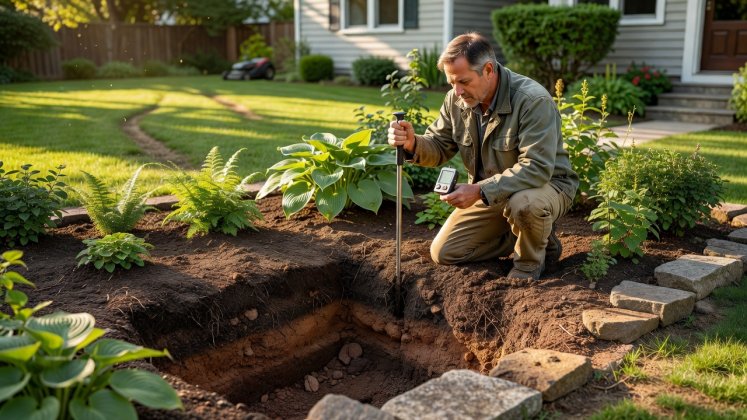
A standard percolation assessment requires digging a cylindrical test pit 30 cm in diameter and 30 cm deep. Presaturate the pit by filling it with water and permitting total drainage. Immediately refill the pit and record the drop in water level hourly using a vertical measuring rule:
- Excessive drainage (over 8 cm per hour): Characteristic of skeletal sands and gravels. Nutrient leaching is severe; moisture-retentive mulches and organic amendments are necessary.
- Balanced drainage (2 to 5 cm per hour): Optimal loam conditions capable of sustaining diverse perennial and woody borders.
- Deficient drainage (under 1.5 cm per hour): Indicates an impermeable clay horizon or subsurface compaction. Planting must utilize water-tolerant taxa such as Cornus sericea or require mechanical elevation into raised beds.
Solar mapping and aspect analysis
Aspect denotes the compass direction toward which a garden slope or boundary faces. In temperate northern latitudes, a south-facing plot receives high-angle, uninterrupted solar irradiance, creating a warm, dry microclimate suitable for Mediterranean perennials like Lavandula angustifolia. Conversely, an east-facing exposure experiences sudden morning heating while soils remain chilled from night radiative cooling, which frequently causes flower bud damage during late spring frosts.
Direct light duration governs photosynthesis. The standard classification dictates that full sun requires six or more continuous hours of unshaded irradiance during the summer solstice. Partial shade constitutes three to six hours, often filtered through high tree canopies such as Betula utilis. Full shade receives under three hours of direct irradiance, necessitating species adapted to diffuse light, including Hosta sieboldiana and native woodland ferns.
Wind exposure, frost pockets, and physical microclimates
Airflow influences both evapotranspiration rates and physiological integrity. Structural barriers like solid masonry walls create turbulent air vortexes on their leeward side rather than smooth shelter. Permeable deciduous hedges dissipate wind kinetic energy far more effectively by filtering air across interlocking branch structures.
Cold air behaves as a fluid, draining downslope under gravity and pooling in low-lying sections or against unperforated fence perimeters. These depressions constitute frost pockets. Sensitive early-flowering shrubs planted within frost pockets suffer chronic tissue necrosis. Identifying these boundaries through simple minimum-maximum ground thermometers prevents structural planting miscalculations.