Planting by requirements
Taxonomic selection should prioritize physical adaptation over aesthetic novelty. A plant established within its evolutionary tolerance band flourishes with minimal chemical intervention, whereas an ill-adapted specimen demands constant corrective labor.
Gardening success rests upon matching known botanical attributes to verified site metrics. This section classifies common ornamental selections by their primary environmental requirements and highlights the physiological mechanisms behind their success or failure.
Heliophytes and drought-adapted perennials
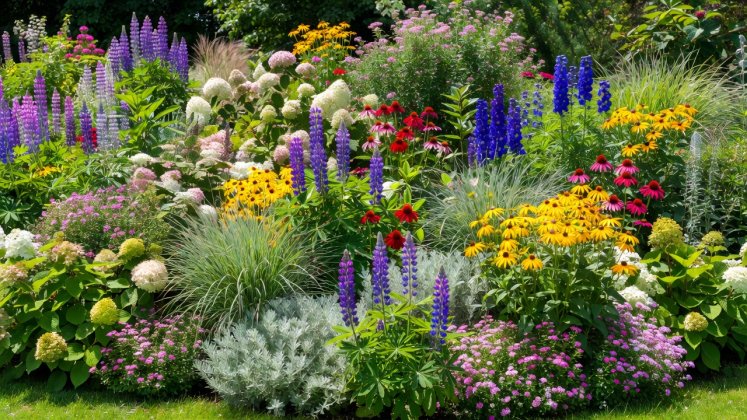
Heliophytes are plants physiologically adapted to high levels of direct solar radiation. Taxa originating from Mediterranean scrub or open steppe, such as Lavandula angustifolia and Salvia nemorosa, have developed structural adaptations to minimize transpiration losses. These traits include epidermal trichomes (surface hairs) that reflect excess photons and trap humid air, thick waxy cuticles, and reduced foliage surface areas.
When cultivated in fertile, water-retentive clays or sheltered shade, these species exhibit rapid, weak vegetative growth, root rot caused by Phytophthora pathogens, and winter dieback. Their establishment requires porous, low-fertility substrates and unrestricted solar exposure. Applying heavy nitrogen fertilizers to these species disrupts internal carbohydrate storage and impairs cold hardiness.
Sciophytes and moisture-retentive shade plantings
Sciophytes are shade-tolerant species whose photosynthetic mechanisms operate efficiently under low light intensities. Hosta sieboldiana and Hydrangea macrophylla illustrate this functional group. These species feature broad, thin leaf lamina with elevated chlorophyll concentrations designed to capture diffuse photons filtered through canopy trees such as Betula utilis.
Because their stomatal regulation responds slowly to abrupt vapor pressure deficits, high-irradiance exposure rapidly leads to marginal leaf scorch and permanent tissue desiccation. Furthermore, Hydrangea macrophylla possesses heavy transpiration demands; if planted in fast-draining sandy loam without continuous irrigation, the specimen wilts repeatedly, causing flower abort and compromised stem lignification before autumn dormancy.
Substrate pH tolerances and nutrient availability
Soil chemical reaction (pH) directly governs the solubility of essential micronutrients and macronutrients. At pH levels above 7.0 (alkaline conditions), iron and manganese precipitate into insoluble mineral forms that plant roots cannot absorb. Calcifuge taxa such as Rhododendron and Camellia develop interveinal chlorosis under alkaline regimes because their physiological mechanisms cannot mobilize iron in the presence of free calcium carbonate.
- Calcifuge Species (Acid-demanding)
- Plants requiring soil pH between 4.5 and 6.0 for nutrient uptake. Examples include Erica carnea and Vaccinium corymbosum. Cultivation in chalky soil causes severe physiological failure unless isolated in ericaceous containers.
- Calcicole Species (Lime-tolerant)
- Species adapted to high-calcium soils with pH ranging from 7.0 to 8.5, such as Syringa vulgaris, Viburnum tinus, and Clematis montana. These taxa tolerate elevated carbonate levels without suffering trace-element deficiencies.
- pH-Adaptable Neutrophiles
- Taxa tolerating a wider pH range between 6.0 and 7.5, provided physical soil drainage is sustained, such as Geranium rozanne and Geranium sanguineum.
Structural grouping and companion compatibility
A frequent design mistake is pairing taxa with fundamentally disparate irrigation and nutrient regimes in the same planting matrix. Placing drought-tolerant Lavandula angustifolia beside high-demand Hydrangea macrophylla forces the gardener into an irresolvable operational conflict: irrigating to sustain the hydrangea inevitably drowns the lavender root system, while restricting water causes the hydrangea to desiccate.
Effective planting design groups species into distinct ecological guilds. Cultivate dry gravel borders together, isolate moisture-loving woodland borders in separate sheltered quadrants, and group architectural shrubs to form cohesive windbreaks that shield delicate understory perennials.