Care through the seasons
Maintenance routines must adapt to plant phenology and environmental shifts rather than rigid calendar dates. Aligning pruning, mulching, and irrigation with biological dormancy cycles ensures long-term garden stability.
Gardening practices performed outside biological parameters disrupt seasonal development. Applying high-nitrogen fertilizers in late autumn stimulates soft vegetative growth that frost destroys, while pruning spring-flowering shrubs during winter eliminates formed flower buds. This chapter outlines seasonal priorities grounded in plant physiology.
Spring emergence and hydration protocols
As soil temperatures exceed 8°C, root metabolic activity resumes before visible shoot elongation. In early spring, newly transplanted woody specimens require deep, infrequent irrigation that encourages roots to grow downward toward lower capillary reserves. Shallow surface sprinkling encourages root growth in the top 5 cm of soil, leaving plants vulnerable during summer dry spells.
Spring mulching should only take place after winter chill has dissipated from the earth. Spreading a dense layer of compost or wood chips over cold, damp spring soil delays root activity by trapping winter ground temperatures. Wait until late spring, when ambient sun has warmed the subsoil, before applying organic mulches.
Summer moisture preservation and mulch thermodynamics
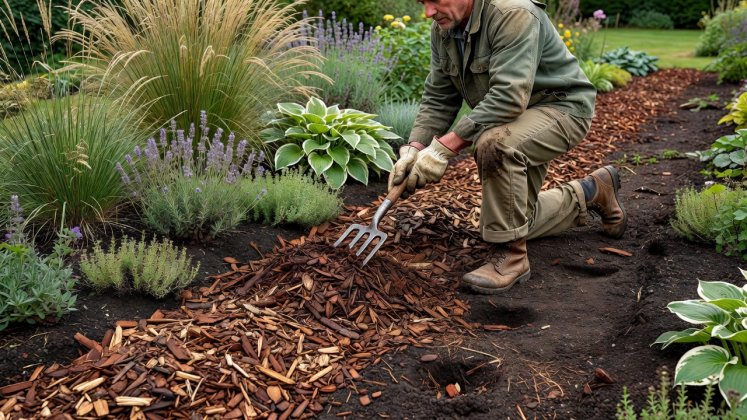
During peak summer irradiance, surface evaporation and plant evapotranspiration deplete soil moisture rapidly. An organic mulch layer 5 to 7 cm deep acts as a thermal buffer, lowering peak root zone temperatures by up to 10°C compared to bare soil, while slowing water vapor dissipation.
Take care to keep mulch material at least 5 cm away from the woody stems and root flares of trees and shrubs. Piling mulch directly against bark creates damp conditions that invite fungal pathogens, cankers, and collar rot. Irrigate borders during early morning hours to minimize evaporative loss and allow foliage to dry before nightfall, reducing foliar powdery mildew risks.
Autumn soil preparation and frost mitigation
Autumn brings declining photoperiods and cooling air temperatures while soils remain warm, making it the ideal window for establishing woody plants and dividing herbaceous perennials. During this period, specimens direct photosynthates downward to expand root systems without losing moisture to leaf transpiration.
Avoid excessive nitrogen fertilization in early autumn. High nitrogen stimulates soft vegetative flushes that cannot develop protective woody tissue before sub-zero temperatures arrive. Autumn management should focus on incorporating compost into surface layers, planting spring bulbs, and applying insulating mulch over the root zones of tender perennials like Salvia nemorosa.
Winter dormant pruning and physiological rest
Dormancy represents a metabolic conservation phase triggered by short days and low temperatures. Deciduous trees and summer-flowering shrubs that bloom on current-season growth, such as Hydrangea paniculata, should be pruned during late winter dormancy. Pruning when leaves are absent allows the gardener to clearly evaluate branching structures and make precise cuts without stimulating early sap flow.
Conversely, spring-flowering woody plants, including Syringa vulgaris, form embryonic flower buds on previous-season wood during late summer. Pruning these shrubs in winter removes the entire coming season's floral display. Schedule pruning for spring-flowering specimens immediately after their bloom period concludes in late spring.
| Season | Physiological Status | Primary Horticultural Operations | Techniques to Avoid |
|---|---|---|---|
| Late Winter (Dormant) | Minimal sap velocity; zero foliar transpiration. | Structural pruning of deciduous trees; dormant fruit tree thinning; soil testing. | Avoid pruning spring-flowering shrubs; avoid working waterlogged clay beds. |
| Mid-Spring (Emergent) | Bud burst; fine root network reactivation. | Hydration assessment; targeted dividing of autumn perennials; selective weeding. | Avoid spreading heavy mulch over cold soil; avoid premature outdoor planting of tender annuals. |
| Mid-Summer (Active) | Maximum evapotranspiration; peak photosynthesis. | Early morning deep watering; maintaining mulch depth; deadheading spent blooms. | Avoid overhead watering during hot midday sun; avoid deep structural branch cuts. |
| Mid-Autumn (Declining) | Carbohydrate relocation to root stores; leaf senescence. | Planting hardy woody specimens; surface compost top-dressing; container protection. | Avoid applying high-nitrogen fertilizers; avoid leaving tender potted plants unsheltered. |