Containers as growing spaces
Container horticulture represents a distinct physiological regime characterized by limited substrate volume, rapid thermal fluctuations, and artificial water drainage boundaries.
A plant confined to a pot cannot extend its root network toward natural moisture reserves or subsurface minerals. The gardener must therefore construct and maintain an engineered growing environment that balances pore aeration, moisture retention, and structural stability.
The perched water table phenomenon in potted substrates
In open ground, gravity draws water downward through soil capillaries without an abrupt boundary. In a container, the boundary between the potting medium and the open air at the base creates surface tension that suspends moisture, forming a saturated zone termed a perched water table. This layer remains waterlogged regardless of how many drainage holes exist, until the weight of the water column overcomes capillary tension.
A shallow container features a perched water table that occupies a substantial fraction of its total height, leaving minimal aerated space for active root development. Conversely, a tall container positions the perched water table at its base, leaving the upper sections well aerated and oxygenated. Placing a layer of coarse gravel or pot shards inside the container bottom does not improve drainage; it merely raises the perched water table higher up the pot profile, effectively decreasing the usable root volume.
Material properties and root temperature dynamics
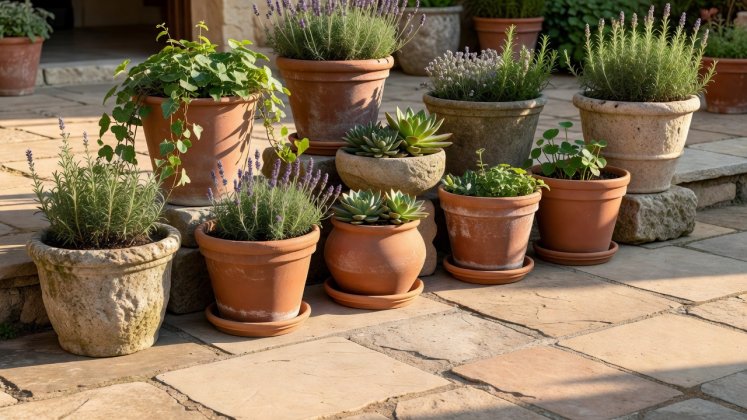
Container wall composition strongly influences root physiology through thermal conduction and evaporative cooling. In unglazed terracotta, water transpires through microscopic porous walls, cooling the root ball during hot conditions. However, this porosity accelerates media desiccation, requiring frequent rehydration during high summer temperatures.
Non-porous vessels, including glazed ceramic, molded polyethylene, and metal, eliminate sidewall transpiration but trap solar radiation. Dark plastic pots exposed to direct southern sunlight can experience internal temperatures exceeding 45°C. Root tip necrosis occurs under these conditions, arresting nutrient uptake even when moisture is available. Shading container exteriors or using double-walled planters mitigates dangerous thermal spikes.
Substrate composition and long-term aeration
Standard topsoil should not be used in containers. Topsoil particles compact rapidly under repeated irrigation, collapsing macro-pores and causing anoxia. Engineered container substrates rely on structural components that resist microbial decomposition while preserving 15% to 25% air-filled porosity at field capacity.
| Substrate Component | Air-Filled Porosity | Water Retention | Functional Purpose |
|---|---|---|---|
| Composted Pine Bark (3–10 mm) | High (25–35%) | Moderate | Provides stable structure, resists compaction, and maintains macro-pore channels. |
| Coarse Perlite / Horticultural Grit | Very High (40–50%) | Negligible | Increases percolation speed; prevents particle stratification in heavy media. |
| Coir / Peat Alternatives | Moderate (10–18%) | High | Retains capillary moisture; requires blending with coarse aggregates to avoid compaction. |
Nutrient depletion and mineral salt accumulation
Because container volumes are restricted, dissolved nutrients leach away rapidly with drainage water. Slow-release controlled fertilizers provide baseline nutrition over three to six months. However, frequent liquid fertilizing can cause unused mineral salts to crystallize on pot walls and media surfaces.
Elevated electrical conductivity from accumulated fertilizer salts exerts osmotic pressure on root membranes, drawing moisture out of root cells and causing leaf tip dieback. Flusing containers once monthly during the active growing season with copious clean water dissolves and clears these accumulated mineral residues.