Reading the garden site
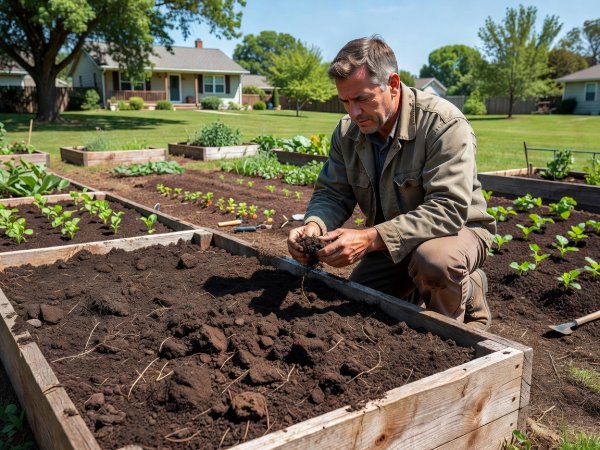
Soil texture analysis, percolation tests, solar mapping, and prevailing wind assessments provide baseline environmental data necessary prior to structural groundwork.
Successful ornamental and productive planting depends on physical environmental constraints rather than decorative intention. Soil composition, cumulative irradiance, and water percolation establish non-negotiable parameters for biological survival.
Horticultural design functions as an analytical exercise in matching plant physiology to localized microclimates. Beginning gardeners who evaluate physical site attributes before selecting taxa reduce specimen mortality and ongoing resource demands. This guide establishes a systematic framework for home cultivation grounded in observation, verified taxonomy, and established horticultural methodology.
Planning an enduring garden layout requires four sequential analytical stages. Each topic explores an isolated horticultural dimension with specific physical criteria.
Soil texture analysis, percolation tests, solar mapping, and prevailing wind assessments provide baseline environmental data necessary prior to structural groundwork.
Selection models based on physiological demands ensure specimens such as Lavandula angustifolia and Hydrangea macrophylla inhabit suitable soil chemistry and light.
Potted horticulture requires modified drainage engineering, substrate aeration, and thermal buffering to sustain root health in restricted volumes.
Phenological scheduling aligns dormant pruning, spring hydration, summer mulch maintenance, and autumn soil cover with natural biochemical cycles.
The core thesis of durable garden design asserts that site remediation is structurally finite, whereas plant selection remains flexible. Placing calcifuge specimens in chalky alkaline soils or heliophytes in deep building shade generates chronic stress that fertilizers cannot correct. Empirical observation of site factors must precede botanical purchasing.
| Site Parameter | Physical Diagnostic | Adapted Botanical Characteristics | Representative Taxa |
|---|---|---|---|
| High Irradiance & Rapid Drainage | Six or more hours of direct summer light; gravelly or sandy loam that empties a 30 cm percolation test pit within two hours. | Silver, glaucous, or tomentose foliage; reduced surface leaf area; deep taproots resistant to low capillary moisture. | Lavandula angustifolia, Salvia nemorosa, Rosmarinus officinalis |
| Low Irradiance & Constant Moisture | Fewer than three hours of direct morning sun; clay-rich substrate maintaining high capillary retention without waterlogging. | Broad, thin laminar foliage maximizing photonic capture; shallow fibrous root network sensitive to drought stress. | Hosta sieboldiana, Dryopteris filix-mas, Hydrangea macrophylla |
| Exposed Airflow & Alkaline Substrate | Unsheltered open perimeter; soil test indicating pH 7.2 to 8.2 with high free calcium carbonate. | Flexible woody stems; tolerance of high soil osmotic pressure; absence of lime-induced leaf chlorosis. | Syringa vulgaris, Viburnum tinus, Cornus sanguinea |
Before purchasing specimen plants, implement the following analytical procedure across one growing cycle when feasible:
Horticultural literature frequently repeats aesthetic recommendations without qualifying their biological boundaries. These entries address fundamental initial questions.
Surface incorporation of organic matter improves soil friability and macro-pore structure within the upper 10 to 20 cm of topsoil. However, if the underlying subsoil consists of dense clay or a compacted hardpan, surface compost will not eliminate the accumulation of subsurface standing water. Severe subterranean compaction requires mechanical deep aeration or raised beds to elevate root zones above the saturated water table.
Aspect determines the duration and thermal intensity of photosynthetic radiation. South-facing borders receive high-intensity direct light that rapidly desiccates shallow substrates, requiring drought-adapted xerophytic selections. Conversely, north-facing walls create cooler microclimates characterized by diffused indirect light and slower evaporation, demanding shade-tolerant taxa with broad photosynthetic surfaces.
The primary cause of specimen failure is water stress arising from container root-bound balling or inadequate post-transplant root-to-soil capillary connection. When a plant with dense nursery root potting is transferred into heavy garden soil without root loosening, water often fails to penetrate the root core or escapes around the root perimeter. Regular deep watering and proper root flare positioning at soil level are critical during the first twelve months.
Your privacy choices We use necessary cookies to run the site and, with your consent, optional ones to measure visits. You can change this at any time. Read more